
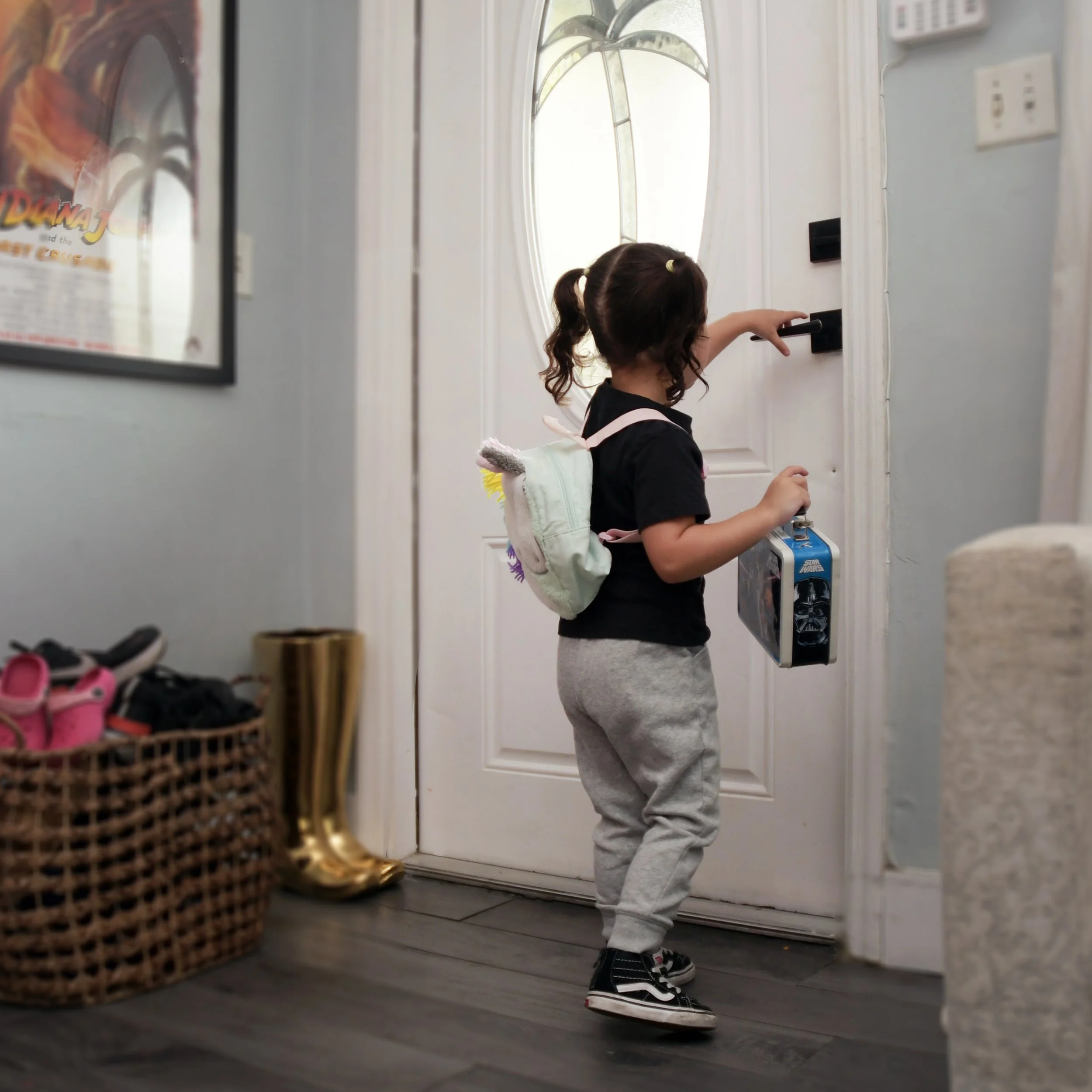
“The goal of a successful school transition is not zero tears. The goal is helping your child practice emotional tolerance.”
When your child cries at school drop-off, hides under the bed because they don't want to get dressed, becomes extra clingy, or tells you they don't want to go to school, your parent brain may immediately think:
Something is wrong. I need to make this stop.
But crying is not necessarily the problem. What they are practicing is one of the most important developmental skills they will need for the rest of their life: emotional tolerance.
Think tummy time, crawling, walking, we understand physical development beautifully. We put a baby on their tummy. They struggle. They practice. They crawl. They pull themselves up. They toddle around holding furniture. Eventually, they walk. Nobody looks at a crawling baby and says, "Why aren't you walking? Try harder." But we do this with emotional development all the time.
A young child is learning:
Emotional tolerance: I can feel something uncomfortable and stay with it.
Self-control: I can begin to stop myself and manage an impulse.
Social reciprocity: I can handle the back-and-forth of being with another human
Being one of many: I can wait. I can share an adult's attention. I don't always get the toy first.
Eventually, these experiences support self-awareness, self-management, social awareness, relationship skills and responsible decision-making. These are not skills children simply have. They practice them daily within relationships and experiences in their social world.
School gives them a lot to practice
Think about what we're asking a young child to do when school begins. Say goodbye to their favorite person. Walk into a new environment. Let another adult care for them. Wait for attention. Share materials and toys. Not know exactly what is going to happen next. That is a developmental workout.
When your child cries because you are leaving, they are experiencing sadness, uncertainty, fear or anger. It does not hurt a child to feel sad, scared, angry or to miss someone they love. That is a natural human response to saying goodbye to someone you love.
What matters is that they are not left completely alone with those emotions. You say goodbye. Their teacher receives them. They cry. The teacher holds them, talks to them, stays close or helps them enter the classroom. Eventually, the emotion comes down. And every time it comes up and comes back down, they are having an experience: "Oh. Feelings come and go." That's practice.
Crying is not the same as being unsafe
This distinction matters. I am not telling you to ignore crying.
There is a difference between a child who cries at separation and gradually settles with the support of another trusted adult, and a child who remains intensely distressed and cannot recover or participate. We pay attention to that. But the existence of tears does not, by itself, tell us that something is wrong.
Sometimes tears tell us exactly what we already know:
I love you. I would rather stay with you. I don't like saying goodbye.
Of course they would rather stay with you. You are their favorite person.
Give the transition time
“Transition is a process, not a three-day event.”
Parents tend to evaluate school transitions in days. Try to think in weeks instead of days. Research on transitions into preschool, childcare and kindergarten shows considerable individual variation in how children respond and adjust. Temperament, relationships with caregivers and teachers, previous experiences and the environment all matter. Some children settle quickly and others need many weeks.
That doesn't mean you ignore what you're seeing; it means you stay curious instead of immediately concluding, "this isn't working." Watch. Communicate with the teacher. Look for whether your child is beginning to build relationships, recover after difficult moments, participate and find predictable pieces of the day. Transition is a process, not a three-day event.
Temperament matters
Some children walk into a new environment and basically say, "Okay, what's happening over here?" Those are your more flexible, lower-reactive children.
Other children take in everything with high intensity and a bit of caution. They are observant. Please stop calling them shy. They walk into a room and need time to look around, understand who is there and decide whether they feel safe.
Then there are the 0-to-10 children. Happy at 10. Mad at 10. Excited at 10. They are big feelers. For both kinds of highly reactive children, transitions may take more time.
One of my favorite books on this is The Orchid and the Dandelion by W. Thomas Boyce. The metaphor is useful: some children are more like dandelions and seem able to grow almost anywhere; others are more like orchids and are more sensitive to their environment. Neither is better; they each just need different things from us.
So what do you actually do?
Keep the goodbye brief
You do not have to wait until your child stops crying before you leave. If you stay until they are calm, the unintended message can become: I need you here in order to become calm.
What we want them to learn is that Mommy takes care of me, Daddy takes care of me, Grandma takes care of me, and my teacher takes care of me.
You already did the hardest part. You chose a setting and adults you trust with your most precious person. Now your child needs the experience of being handed lovingly to that teacher, even while crying, and discovering: Mommy leaves, my teacher takes care of me, and then Mommy comes back. That experience is how the new relationship begins to feel safe.
Build a consistent morning routine
Routine is boring for adults. It is necessary for a developing brain. Routine is not so much about the exact time. It is about the pattern. We wake up, we have breakfast, we get dressed, we get in the car. First this, then this, then this.
That predictability gives children something they can understand when so much about starting school is new. You do not need to worry about teaching a young child spontaneity. You don't have to create that. Someone will take their block. It will rain when they expected to go outside. Mommy will sneeze. Another child will want the same toy. Life gives them uncertainty all day long. Uncertainty is the rule. Routine is what we have to create.
Stop trying to convince them
When your child says, "I don't want to go to school," there is no convincing. You do not need a TED Talk about why school is wonderful. You can say, "I know. It's hard. You're still getting used to school." Then you continue with the morning. Sometimes we talk too much.
They can be sad while you help them put on their shirt. They can cry while you put on their shoes. If you can, add a little playfulness: "Should we put your shirt on in the bedroom or in the kitchen?" But you don't have to wait for them to agree with you. You can understand the feeling, hold the boundary, and keep moving.
Make drop-off predictable
Choose how you are going to do drop-off and then, as much as possible, do it that way. Every time you introduce a new option, you add it to your child's dropdown menu. If sometimes you walk them inside, sometimes Grandma drops them off, sometimes you stay for 20 minutes, and sometimes you leave quickly, of course they're going to ask for the version they like best. And usually the version they like best includes more of you.
So choose something you can actually maintain. Tell them how they are getting to school, who will receive them, and what the goodbye will look like. The goal is not to find the drop-off that makes them stop crying. The goal is for them to know, this is how we do school.
Keep sleep, food and naps as consistent as possible
You know what happens to your emotional tolerance and stress when you haven't slept or eaten. Your child's system is even less mature. One of the things schools do very well is create rhythm. Children begin to know when they eat, when they play, when they rest, and what comes next. If you can keep meals, naps and sleep reasonably close to that rhythm at home, especially while they are transitioning, it helps.
And if you already planned a vacation, don't panic. You can travel. You can have grandparents visit. Life can happen. Just hold onto the basics as much as you can: eating, sleeping, resting, and the familiar morning and evening patterns.
Don't promise that school will be fun
Please don't tell them, "You're going to have so much fun!" That's a lie. School isn't fun 100% of the time. Sometimes somebody has the doll you want. Sometimes you have to share. Sometimes you have to wait for an adult to look at you. Sometimes you don't know how to do something the first time. Sometimes you simply miss Mommy.
Tell them the many reasons they go to school. They go to learn. They go to play. They go to learn how to be a friend. They go to learn how to be one of many. And let them know that all kinds of feelings will happen at school. They will be happy and excited, and they will also be disappointed, frustrated, angry and sad.
That's the point. They are practicing emotional tolerance: Some of this will feel good. Some of this will feel hard. They will learn they can handle both.
Don't interrogate them at pickup
They have spent the day being one of many, waiting, sharing attention, following a routine and managing a lot of information. Then they see you, their favorite person, and they finally get to exhale. That is probably not the moment for questions. Give them a snack. Play their favorite song. Tell them you're happy to see them. Be quiet for a little while.
“Broad questions require a young child to search an entire day and figure out what you want to know. Specific questions bring the memory back.”
Then, later, instead of asking, "Did you have fun?" or "How was school?" use specific information. "What did you do on the playground?" "What happened in the book your teacher read?" "Who sat next to you at snack?" Broad questions require a young child to search an entire day and figure out what you want to know. Specific questions bring the memory back.
Sometimes after school they don't need us to get more information out of them. They just need us, our presence, and calm connection.
One last thing about emotions,
Neuroanatomist Jill Bolte Taylor popularized what she calls the 90-second rule, the idea that the first physiological wave of an emotion can move through the body relatively quickly if we do not keep retriggering it with the story we attach to it.
I do not use 90 seconds as a stopwatch for children. I use it as a reminder that emotions are not permanent states. They rise, they peak, and they come back down. Young children do not know that yet. Part of emotional tolerance is having enough repeated experiences to learn, I can feel something this big and it will change.
That is why our goal cannot be to make sure children never feel the wave. Our job is to stay close enough, calm enough, and predictable enough that they begin to learn how to move through it.
So when your child cries at drop-off, try not to use no crying as the measure of whether the transition is going well. Give the hug. Say the goodbye. Hand the baton to the trusted adult and allow your child to have the experience.
They are not failing the transition because they are sad. They may be practicing exactly what they need to learn.